
What Is Smart Logistics, and Why Does It Matter?
Global trade is moving faster than ever, and the businesses winning today are not necessarily the biggest; they are the smartest. At the center of this shift is a concept reshaping how goods, data, and decisions move across borders: Smart Logistics.
For courier operators, freight forwarders, e-commerce businesses, manufacturers, and government agencies alike, understanding Smart Logistics is no longer optional. It is the difference between organizations that scale efficiently into Africa’s growing trade economy, and those that get left behind by rising costs, delays, and inefficiency.
Defining Smart Logistics
Smart Logistics refers to the use of technology, data, and intelligent systems to plan, execute, and optimize the movement of goods, information, and resources across the supply chain. It combines traditional logistics functions — warehousing, transportation, freight, and distribution — with digital tools such as:
– Real-time tracking and visibility systems, giving businesses and customers live status on shipments
– Data analytics and predictive planning, used to forecast demand, prevent delays, and reduce waste
– Automation and digital documentation, replacing slow manual processes with faster, error-free workflows
– Interconnected systems, allowing suppliers, carriers, warehouses, and customers to operate on shared, transparent information
In simple terms: Smart Logistics replaces guesswork with visibility, and delay with speed.
Why Smart Logistics Matters, Especially in Africa
Africa’s trade volume is expanding rapidly, driven by e-commerce growth, cross-border agreements like the African Continental Free Trade Area (AfCFTA), and increasing investor interest in the continent’s logistics infrastructure. Yet many logistics operations across the region still rely on outdated, manual processes that create bottlenecks at ports, borders, and last-mile delivery points.
This is precisely where Smart Logistics becomes a competitive advantage:
1. It reduces cost and waste. Predictive planning and route optimization cut fuel costs, storage costs, and the losses that come from delays or damaged goods.
2. It builds trust with customers and partners. Real-time visibility means businesses can give accurate delivery timelines — a critical factor in customer retention and B2B partnerships.
3. It strengthens resilience. Smart systems help businesses anticipate disruptions — whether from weather, customs delays, or demand spikes- instead of reacting to them after the damage is done.
4. It attracts investment. Investors and international partners are increasingly selective about which logistics operators and markets they back. Companies and regions that demonstrate smart, tech-enabled logistics capability are far more attractive for capital and partnership.
5. It positions Africa as a serious player in global trade. Smart Logistics is not just an operational upgrade — it is a signal to the world that African supply chains can compete on efficiency, transparency, and reliability.
The Human Side of Smart Logistics
It is worth noting that Smart Logistics is not only about software and systems — it is about people. The professionals who plan routes, manage fleets, oversee warehouses, and negotiate freight are the ones who ultimately determine whether “smart” tools translate into real business results. This is why capacity building, professional training, and industry-wide standards matter just as much as the technology itself.
An organization can adopt every digital tool available, but without skilled logistics professionals who understand how to interpret data, manage relationships, and make strategic decisions, the full value of Smart Logistics is never realized.
Where This Conversation Continues: CLMI International Investor Conference 2026
This growing shift toward smarter, more connected, more investable logistics systems is exactly the conversation the Courier and Logistics Management Institute (CLMI) is convening this year.
CLMI 2026 International Conference and Investiture
Theme: “Powering African Trade and Entrepreneurship Through Smart Logistics”
The conference will bring together courier and logistics executives, government stakeholders, investors, freight and supply chain leaders, and entrepreneurs to explore how Smart Logistics can unlock trade growth, attract investment, and strengthen Africa’s position in global commerce.
Delegates and partners can expect:
– High-level dialogue with CEOs, industry leaders, and government stakeholders
– Insight into investment opportunities across the logistics and courier value chain
– Networking with decision-makers shaping the future of African trade
– Business exposure through exhibitor booths and corporate showcases
– Direct access to policy conversations shaping the industry’s direction
Smart Logistics is not a future trend — it is the current standard the market is moving toward. The question for every logistics business, investor, and organization is simple: will you be shaping that future, or catching up to it?
Categories
Tags
#Article
#Article #Ballsbridge #Socialmedia #marketing #business #lagos
#ballsbridge
#BehaviouralChange
#blog
#Brandawareness
#business
#BusinessMistakes #LogisticsErrors #CLMIEducation #FixYourProcess #NaijaSMEs
#cancer
#clmi
#clmi2025
#CLMIEducation
#coaching
#collaboration
#conference
#courier
#culture
#december
#Ecologicalrisks
#ecommerce
#employee
#entrepreneurship
#FacilityModernization
#finance
#GovernanceAndGrowth
#governmentpolicy
#humanresource
#investiture
#LeadershipStartsWithYou
#Logistics
#management
#ManagementEnforcement
#marketing
#motivation
#NBCC
#Networking
#news
#Nigeria
#pharmaceutical
#PPECompliance
#ProfessionalGrowth
#profitability
#publichealth
#RiskPerception
#TimeManagement #ProductivityHacks #CLMIEducation #WorkLifeBalance #CareerSuccess #EfficiencyMatters #LogisticsManagement
You May Also Like

ABSTRACT The study examined how election logistics and financial oversight are associated with the inclusivity and transparency of elections in...
-
-
September 4, 2026

UNDERSTANDING BALLSBRIDGE UNIVERSITY Legal Status, Global Recognition & Academic Standards In Affiliation with the Courier and Logistics Management Institute (CLMI)...
-
-
August 12, 2026
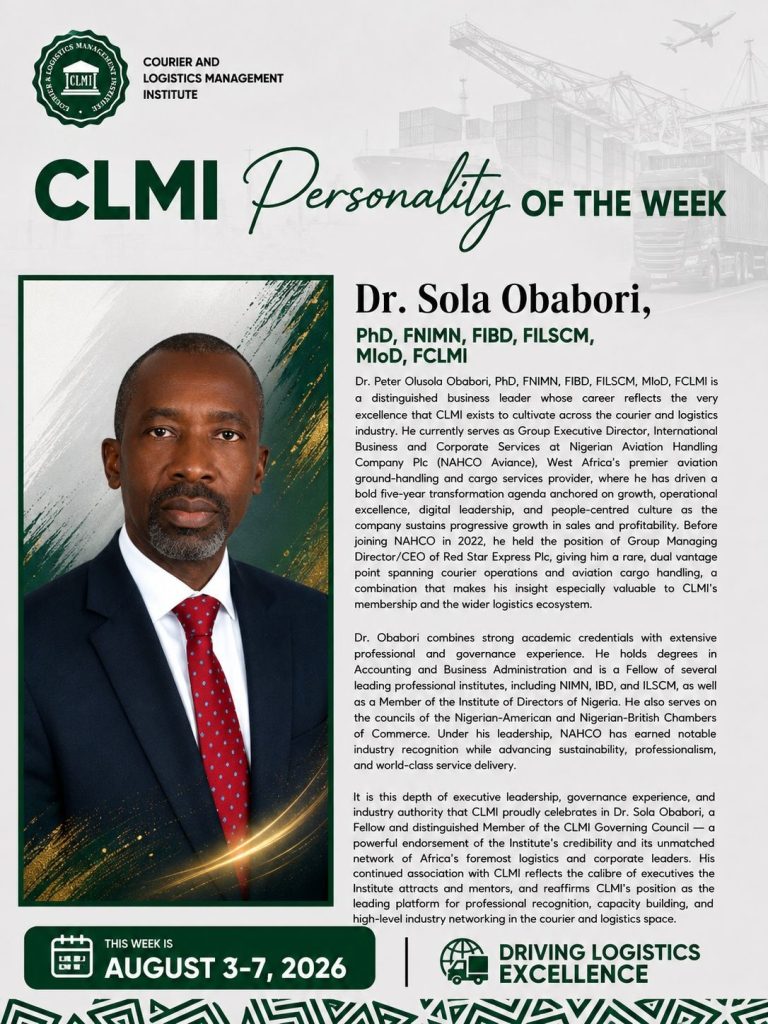
This week, the Courier and Logistics Management Institute (CLMI) proudly celebrates Dr. Peter Olusola (Sola) Obabori, PhD, FNIMN, FIBD, FILSCM,...
-
-
August 7, 2026