Why capacity building is no longer optional — and how professional training is shaping the future of courier and logistics in Africa and beyond.
Every parcel has a journey. From the merchant’s shelf to the customer’s doorstep, through customs clearances, cold chains, last-mile routes, and fleet dispatch systems, something invisible holds the entire process together: the competence of the people who manage it. In a sector that touches nearly every aspect of modern life, the quality of logistics professionals determines not just delivery speed — but economic growth, supply chain resilience, and national competitiveness.
Yet for decades, courier and logistics management across much of Africa has been treated as an operational function rather than a professional discipline. The result has been predictable: talented individuals working without structured frameworks, companies scaling without institutional knowledge, and an industry struggling to meet the demands of a rapidly digitalising, globally connected economy.
The Courier and Logistics Management Institute (CLMI) was founded on a simple but urgent conviction — that the people who move the world deserve world-class training.
THE CASE FOR CAPACITY BUILDING
Why Training Is the Most Profitable Investment a Logistics Organisation Can Make
Capacity building is not a soft concept. It is the deliberate, structured process of equipping individuals and organisations with the knowledge, skills, and systems necessary to perform effectively — and to sustain that performance over time. In logistics, the stakes are viscerally high.
“An untrained workforce in logistics doesn’t just lose parcels — it loses trust, market share, and, ultimately, the contracts that sustain livelihoods.”
— CLMI Faculty, Operations Management Track
Consider the cascading effect of a single weak link: a fleet supervisor who cannot read a route optimisation report; a customs officer unfamiliar with current trade documentation standards; a warehouse manager applying manual pick-and-pack processes while competitors automate. In each case, the individual is not the failure — the absence of structured training is.
These are not abstract statistics. They represent real businesses haemorrhaging revenue, real employees whose careers plateau unnecessarily, and real economies where supply chains remain fragile despite enormous potential. Capacity building is the intervention that changes these numbers — not incrementally, but fundamentally.
WHAT CLMI OFFERS
A Professional Home for Logistics Practitioners at Every Stage0
The Courier and Logistics Management Institute was designed from the ground up to address the sector’s most critical gaps. Unlike generic business programmes that treat logistics as a footnote, CLMI’s curriculum was developed by practitioners, for practitioners — grounded in the realities of African markets while aligned with international standards.
CLMI programmes span the full arc of a logistics career. Whether you are a dispatch rider seeking to formalise your expertise, a mid-level manager preparing for senior leadership, or an executive overseeing regional operations, there is a structured pathway designed precisely for where you are and where you want to go.
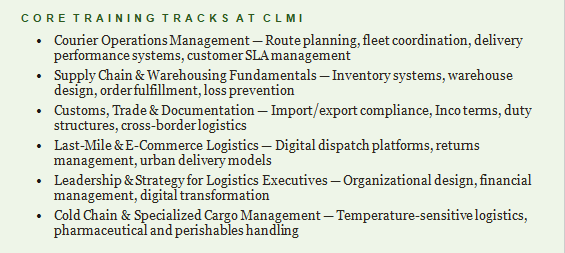
Every programme is built around active learning — not lectures delivered into passive notebooks. CLMI participants work through case studies drawn from real courier operations, engage in peer-to-peer problem solving, and leave each session with tools they can deploy the following Monday morning.
THE BIGGER PICTURE
Individual Growth, Organisational Strength, National Competitiveness
The impact of CLMI training does not stop at the individual. When a logistics manager deepens their expertise in route optimisation, their entire fleet becomes more efficient. When a customs specialist masters trade documentation, their company’s clearance times drop — reducing holding costs that are ultimately borne by consumers. When a senior executive gains the strategic literacy to evaluate technology investments, the entire supply chain they oversee becomes more resilient.
This is the compounding logic of capacity building: every trained professional multiplies their impact across their team, their organisation, and their industry. In a sector as interconnected as logistics, where a single weak link can delay an entire supply chain, the value of a well-trained workforce is impossible to overstate.
“A country whose logistics professionals are well-trained is a country whose economy can move goods faster, cheaper, and more reliably. That is a competitive advantage that shows up in GDP.”
— Director of Programmes, CLMI
Nigeria, and indeed the broader West African region, stands at an inflection point. The growth of e-commerce, the expansion of continental free trade under the AfCFTA, and the increasing sophistication of both local and international supply chains are creating enormous demand for skilled logistics professionals. The question is not whether trained practitioners will be needed — they already are. The question is whether Nigerian logistics professionals will be the ones filling those roles, or whether international expertise will be imported to fill the gap.
CLMI exists to ensure that the answer is definitively local. Trained here. Leading here. Competing everywhere.
A DECISION WORTH MAKING NOW
The Cost of Not Training Is Greater Than the Cost of Training
There is a common objection to professional development in the logistics sector: “We’re too busy moving goods to pause for training.” It is an understandable pressure. Logistics is relentless — the consignments do not wait, the deadlines do not shift, and the phones do not stop ringing.
But this is precisely the logic that keeps organisations trapped in operational firefighting. The manager who is too busy to learn better systems will always be too busy. The organisation that cannot pause to build capability will always be reactive rather than strategic. The industry that treats training as a luxury will always be outcompeted by one that treats it as infrastructure.
CLMI programmes are designed with working professionals in mind — flexible scheduling, modular delivery, and cohort structures that allow you to continue your responsibilities while building the competence that will transform them. Training is not an interruption to your career. It is its acceleration.
Begin Your Professional Journey with CLMI
Whether you are an individual practitioner or an organisation looking to build institutional capacity, CLMI has a programme designed for your next step.
Contact CLMI today to explore enrolment options and upcoming cohort dates.
| Begin Your Professional Journey with CLMI |